
Heroor Hanging Bridge: The Definitive Guide to Udupi’s Offbeat Suspension Footbridge
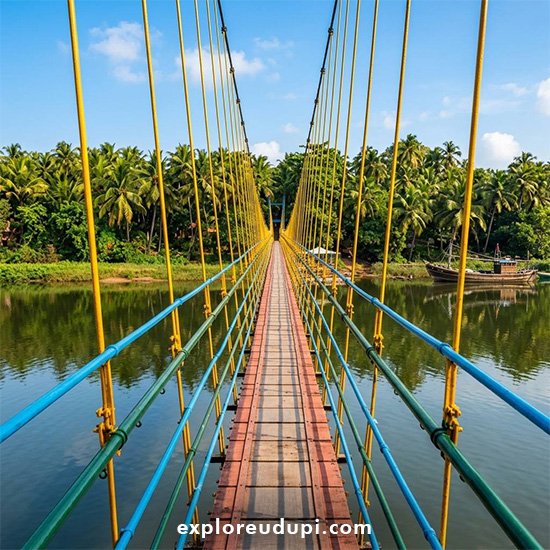
Coastal Karnataka is a mesmerizing land where swift-flowing western rivers carve through lush agrarian valleys before merging into the expansive Arabian Sea. While national highways and concrete bridges dominate major transit corridors, the true soul of Udupi’s rural topography is experienced through its quiet network of pedestrian suspension footbridges. Among these, the Heroor Hanging Bridge stands out as a remarkable yet blissfully uncommercialized engineering landmark. Spanning the tranquil waters of the Madisalu River, this 130-meter-long structure serves as an essential community lifeline while offering travelers an intimate window into unspoiled backwater life.
Tucked away from the bustling tourist circuits of Malpe Beach and the Udupi Sri Krishna Matha, Heroor provides a serene escape for solo explorers, bird watchers, landscape photographers, and students from nearby Manipal seeking a quiet evening surrounded by nature. This comprehensive guide explores everything you need to know about visiting the Heroor Hanging Bridge, from its historical context and river ecology to practical travel routes and safety etiquette.
At a Glance: Quick Facts & Visitor Info
Geographical Setting & The Madisalu River Ecosystem
To truly appreciate the charm of the Heroor Hanging Bridge, one must understand the unique hydrology of the region. The bridge is constructed over the Madisalu River, a serene tributary stream that feeds into the broader Udupi backwater network. Unlike turbulent mountain torrents, the Madisalu moves with a gentle, glassy grace, reflecting the shifting hues of the sky from dawn till dusk.
The banks of the river are framed by a rich, semi-tropical ecosystem. Dense clusters of coconut palms, areca nut plantations, and wild screw pine (Ketaki) bushes line the water's edge. This habitat supports a thriving population of resident and migratory waterbirds. Visitors standing quietly on the bridge during the early morning hours can regularly spot Indian pond herons, little egrets, white-breasted waterhens, and occasionally the flash of an azure kingfisher diving for small fish.
During the monsoon season, the river swells dramatically, its tea-colored waters flowing briskly right beneath the wooden deck of the bridge. In contrast, the post-monsoon and winter months see the water settle into a tranquil mirror, creating pristine conditions for scenic reflection photography.
Structural Design & Engineering Anatomy
Measuring roughly 130 meters in length, the Heroor Hanging Bridge is a classic suspension footbridge engineered to bridge rural isolation without altering the ecological flow of the river below. The structural framework relies on several core components:
- Anchor Pylons: Robust reinforced concrete towers planted firmly on either riverbank bear the massive downward and lateral tension loads of the deck.
- High-Tensile Steel Cables: Thick, galvanized steel wire ropes sweep in a parabolic curve across the span, anchored deep into concrete footings on both sides. These primary cables support secondary vertical suspenders.
- Walkway Decking: The walking surface consists of sturdy wooden planks or reinforced metal grates secured over cross-beams. As pedestrians walk across, the deck responds with a characteristic, gentle flexibility—a dynamic movement that gives suspension bridges their thrilling, airy feel.
- Side Railings: Protective wire-mesh and hand-rail systems run the entire length of the span, ensuring complete safety for pedestrians while keeping unobstructed windows open for river views.
Socio-Economic Importance: Connecting Heroor and Uppuru
While modern tourism highlights its aesthetic value, the primary purpose of the Heroor Hanging Bridge is purely utilitarian. Constructed over a decade ago, the bridge serves as a critical pedestrian and light-transit corridor linking the rural settlements of Heroor and Uppuru.
Before the bridge was built, villagers, school children, and farmers wishing to cross to the opposite bank were forced to take long, cumbersome detours using larger vehicular road bridges further inland or rely on seasonal local boats. By cutting across the river directly, the footbridge drastically reduces travel time between the neighborhoods. It is common to see local residents pushing bicycles across the bridge, returning from local markets, or heading to nearby agricultural fields, embedding the structure deeply into the daily rhythm of rural coastal life.
Local Traveler Insight: Because Heroor is primarily a functional community bridge rather than a heavily packaged tourist site, visitors get an unvarnished, authentic look at rural life in Udupi, free from commercial stalls, ticket lines, or tourist traps.
The Offbeat Visitor Experience & Atmosphere
For travelers seeking a break from urban noise, Heroor offers an atmosphere of profound stillness. The ambiance shifts dramatically depending on the time of day:
Morning Solitude
Arriving shortly after sunrise (around 6:30 AM to 7:30 AM) reveals a misty river valley. The air is cool, carrying the crisp scent of damp earth and river silt. Local fishermen can often be seen casting traditional nets from wooden canoes, and the golden morning light filters through the coconut fronds, casting dramatic shadows across the water.
Evening Wind Down
In the late afternoon (after 4:30 PM), a gentle breeze picks up across the backwaters. The bridge begins to sway slightly with the gusts, providing an exhilarating yet completely safe sensation. Watching the sunset from the middle of the bridge—where the western horizon opens up above the river bend—is a peaceful, meditative experience.
Photography, Videography, and Content Creation Tips
With its rustic symmetry and verdant surroundings, Heroor is a hidden gem for content creators. Keep these tips in mind to capture stunning frames:
- Leading Lines: Stand at either entrance of the bridge and shoot down the length of the deck. The converging steel cables and railings create powerful geometric leading lines that draw the viewer's eye straight to the center.
- Drone Operations: If you fly a drone, the aerial perspective of the bridge cutting straight across the winding green curve of the Madisalu River framed by dense coconut groves yields breathtaking cinematic footage. (Always ensure local drone regulations and safety clearances are respected).
- Reflections: On calm winter afternoons, the water acts as a mirror. Shoot from a low angle near the bank to capture dual reflections of the bridge structure and the surrounding foliage.
Step-by-Step Directions: How to Reach Heroor
Navigating to Heroor requires careful attention, as it is tucked away inside rural interior roads rather than directly on the main highway:
- From Udupi City / Manipal: Head north toward Brahmavar or Santhekatte via National Highway 66 (NH66). The distance from Udupi city is roughly 10 to 12 kilometers.
- Turning Inland: As you approach the Heroor/Uppuru vicinity, look out for local interior turnoffs leading toward the riverbanks. Digital navigation apps (like Google Maps) can successfully guide you down the final village lane.
- Vehicle Recommendations: The approach roads leading directly to the footpaths of the bridge are notably narrow. While cars can navigate some segments, parking spaces near the immediate bridge approach are extremely limited. It is highly recommended to travel by two-wheeler or hire an auto-rickshaw from a nearby highway junction for a hassle-free trip.
Essential Visitor Guidelines & Etiquette
To preserve the pristine charm of Heroor and maintain cordial relationships with local residents, visitors should adhere to a few simple rules:
- Yield to Local Commuters: Remember that this is an everyday pathway for villagers. Step aside, pause your photo sessions, and give right-of-way to locals carrying goods, pushing bicycles, or walking home from work.
- No Reckless Rocking: While suspension bridges naturally flex and sway under body weight, intentionally jumping, running aggressively, or shaking the cables to scare others is dangerous and disrespectful to elders crossing the bridge.
- Strict Zero-Litter Policy: There are no municipal trash cans installed directly on the bridge. Pack out everything you bring—plastic water bottles, wrappers, and containers must be carried back with you.